Eco Resorts in Baa Atoll, Maldives
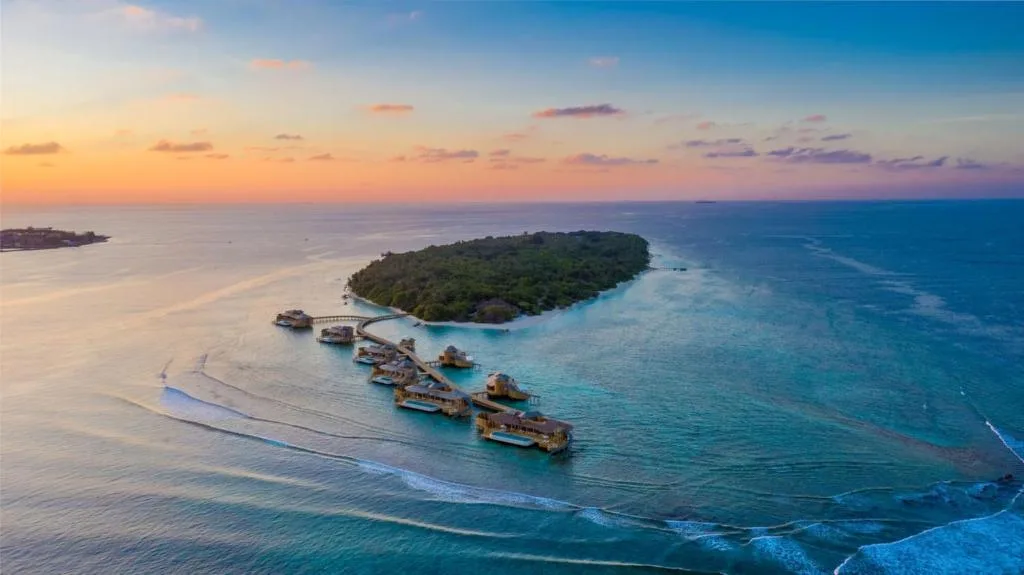
Soneva Fushi is the reference point for eco-minded travel in Baa Atoll: villas tucked into dense island vegetation, signature outdoor bathrooms built into private gardens, free bicycles instead of buggies, and a Barefoot Butler system that replaces a lot of the usual resort infrastructure with personal service. Baa Atoll's whole-atoll UNESCO Biosphere Reserve status already sets a higher bar for how resorts treat the reef and lagoon around them, and Soneva Fushi builds on that with its own sustainability programs on top of the island's natural cover. The trade-off for a lighter footprint is usually a slower pace, bicycles instead of golf carts, open-air spaces instead of air-conditioned lobbies, which suits travelers who came for the biosphere reserve as much as the villa.
The eco-resort side of Baa Atoll trades polish for texture: vegetation left dense instead of manicured, bicycles instead of buggies, and outdoor bathrooms instead of enclosed suites. It rewards travelers who want the atoll's UNESCO Biosphere Reserve status to show up in daily details, not just a line in the brochure.
Eco Resort · Baa Atoll in numbers
Where to stay
Inside an eco-resort stay in Baa Atoll
An eco-resort stay in Baa Atoll works because the atoll's UNESCO Biosphere Reserve framework already asks resorts to manage reef and lagoon impact carefully, so a property built around sustainability, like Soneva Fushi, isn't fighting the local rules so much as leaning further into them. Dense native vegetation keeps villas shaded and separated without extra construction, and outdoor, garden-set bathrooms cut down on enclosed air-conditioned space compared with a standard indoor suite. The result tends to favor barefoot, slow-paced days: bicycles over buggies, open-air dining over enclosed restaurants, and excursions like the open-air Cinema Paradiso instead of an indoor entertainment complex.
Soneva Fushi's villas sit inside dense island foliage rather than cleared garden plots, which keeps the resort's footprint smaller and gives every villa natural shade and privacy without much added structure. The outdoor bathrooms, open to private gardens, are the property's signature detail and a direct expression of the eco-resort approach: fewer enclosed, air-conditioned rooms, more spaces that use the island's own climate. Guests get around Soneva Fushi by complimentary bicycle rather than golf buggy, which fits the same logic and, as a side effect, makes exploring the island's own paths part of a Baa Atoll stay rather than a transfer between points.
The house reef at Soneva Fushi benefits from the same UNESCO Biosphere Reserve protections that cover the rest of Baa Atoll, and an eco-resort's lower-impact operations, less construction, more shade from existing vegetation, tend to leave that reef in better shape over time than a heavily built-up shoreline would. Snorkeling straight off the beach is part of the daily rhythm here, and the resort's sustainability programs extend to how waste, water and energy are handled on an island that, unlike a mainland hotel, has to manage all of it locally. The wet season, roughly May to November, is also when Hanifaru Bay's manta ray and whale shark aggregation peaks, so travelers timing a stay around wildlife often overlap the two.
A Barefoot Butler assigned for the stay replaces a lot of the usual front-desk-and-concierge structure with one point of contact, which is both a service style and, indirectly, a lighter operational footprint since fewer separate departments are involved in a single request. Evenings often end at the open-air Cinema Paradiso, a screening space built without walls, which uses the trade winds instead of air conditioning and turns a film night into an outdoor, stargazing-adjacent activity rather than an indoor one. Velana International Airport remains the entry point for every route into the atoll, whether the onward transfer runs by seaplane, domestic flight or speedboat.
Reaching an eco-resort like Soneva Fushi in Baa Atoll still means a seaplane transfer from Velana International Airport, and the flight itself is worth treating as part of the sustainability story: seeing the atoll's reef patterns and lagoon shapes from the air makes the case for why the resort below protects them so carefully. Because eco-resorts here tend to run smaller guest counts to limit impact, availability during the wet-season manta months, roughly May to November, can book out earlier than at larger, higher-density resorts in the atoll. That combination of protected reef and remote geography is specific to Baa Atoll rather than something every Maldives atoll offers in equal measure.
A traveler's takeWe stayed at Soneva Fushi and the bicycle habit stuck immediately, cycling to breakfast through the trees felt more like the point of the trip than a way to get somewhere. Our Barefoot Butler sorted a Hanifaru Bay snorkeling trip and a stargazing session at the open-air cinema in the same afternoon, no separate concierge calls needed. The outdoor bathroom took one shower to love and every one after that to miss when we got home.
Local tips
- 1Book Soneva Fushi or another eco-resort well ahead for May to November, when demand from the manta season stretches across smaller-footprint, lower-room-count properties fastest.
- 2Pack for a bicycle-based island; flat, closed shoes work better for daily riding than sandals, especially on sandy paths after rain.
- 3Ask your Barefoot Butler to bundle requests rather than making separate calls, since the whole point of the system is one contact handling everything.
- 4Bring reef-safe sunscreen specifically, since eco-resorts in a UNESCO Biosphere Reserve are especially strict about what touches the house reef.
- 5Check whether your outdoor bathroom needs any weather-specific packing, like a light rain layer, since garden-set bathrooms are more exposed than enclosed ones.
- 6Reserve a seat at the open-air cinema or a stargazing session early in your stay rather than waiting, evening slots fill fast at smaller eco-resorts.
Related searches
Eco Resort · Frequently asked
Villas sit within dense natural vegetation instead of cleared gardens, bathrooms are open-air within private gardens rather than fully enclosed, guests move around by bicycle instead of buggy, and the resort runs its own sustainability programs on top of Baa Atoll's UNESCO Biosphere Reserve rules.